EV Rebates Shrink From 1 Jan 2027: What Changes for You
Electric cars registered from 1 January 2027 lose the EEAI and get a smaller VES rebate. What changes, why the registration date matters, and what it means if you sell.
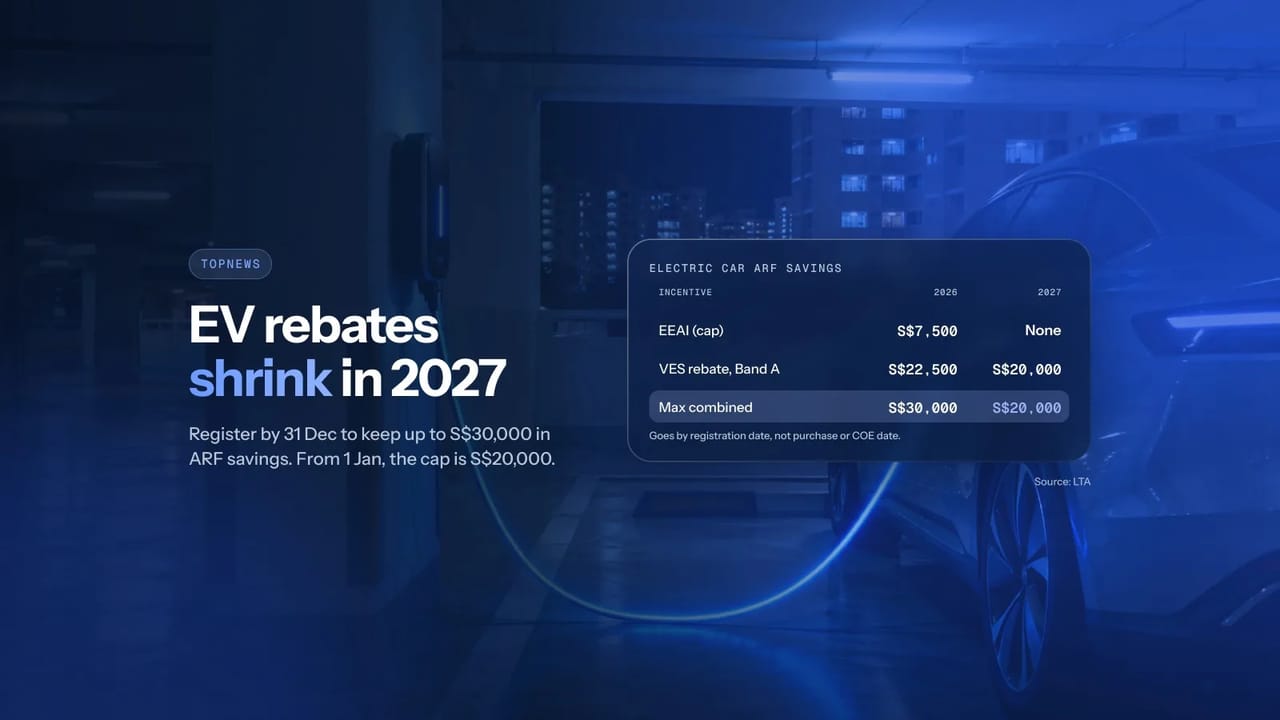
Electric cars registered in Singapore from 1 January 2027 will get smaller tax rebates than those registered this year. The EV Early Adoption Incentive (EEAI) ends on 31 December 2026, and the top Vehicular Emissions Scheme (VES) rebate for cars falls from S$22,500 to S$20,000. Together, the most an electric car can save on its Additional Registration Fee (ARF) drops from S$30,000 to S$20,000.
With three COE bidding exercises left in 2026, here's what is changing, why the registration date matters, and what it could mean if you're buying or selling.
Information as of 4 November 2026.
What changes on 1 January 2027
LTA and NEA announced the changes in September 2025, when they extended both schemes for electric vehicles. Here's how 2026 and 2027 compare for an electric car.
Incentive | Registered in 2026 | Registered in 2027 |
|---|---|---|
EV Early Adoption Incentive (EEAI) | 45% off the ARF, capped at S$7,500 | Ends. No EEAI. |
VES rebate, top band (Band A) | S$22,500 | S$20,000 |
Maximum combined ARF savings | Up to S$30,000 | Up to S$20,000 |
ARF floor for electric cars | S$0 | S$0 (until 31 December 2027) |
Source: LTA and NEA, 8 September 2025; LTA, Transitioning to EVs, last updated 17 September 2026.
The VES itself runs until 31 December 2027. Under the revised scheme that started on 1 January 2026, only electric vehicles get VES rebates. Hybrids no longer qualify, and more polluting cars face higher surcharges. LTA says the incentives will continue to taper as Singapore works towards all new cars being cleaner-energy models by 2040.
Why the registration date matters
Both incentives follow the date a car is registered, not the date you sign for it or the date its COE was won. A car booked in December but registered in January gets 2027's rebates.
That matters because of how COEs work. A winning bidder receives a Temporary COE, which for Cat A and Cat B must be used to register a car within six months. A COE won in the last exercise of the year still leaves plenty of time to register, but it doesn't leave much time to register in 2026.
Bidding exercise | Closes | Days left in 2026 after results |
|---|---|---|
November 1st | Wed 4 Nov, 4pm | 57 |
November 2nd | Wed 18 Nov, 4pm | 43 |
December 1st | Wed 9 Dec, 4pm | 22 |
December 2nd | Wed 23 Dec, 4pm | 8 |
Source: LTA OneMotoring, COE bidding schedule for 2026. Days counted from the closing date to 31 December.
If you're buying an electric car and want 2026's rebates, ask your dealer when the car will be registered, not just when it will be delivered. If the paperwork could slip into January, ask how the price changes.
What it could cost: two worked examples
The ARF is worked out from the car's Open Market Value (OMV), the import value assessed by Singapore Customs. For cars with COEs from the second February 2023 exercise onwards, the first S$20,000 of OMV is charged at 100%, the next S$20,000 at 140%, the next S$20,000 at 190%, and so on. The rebates are then taken off the ARF.
Here are two made-up electric cars, both assumed to qualify for the top VES band.
Step | Car 1 (OMV S$35,000) | Car 2 (OMV S$45,000) |
|---|---|---|
ARF before rebates | S$41,000 | S$57,500 |
Registered in 2026: EEAI | Less S$7,500 (45% would be more, so the cap applies) | Less S$7,500 (capped) |
Registered in 2026: VES Band A | Less S$22,500 | Less S$22,500 |
ARF payable, 2026 | S$11,000 | S$27,500 |
Registered in 2027: VES Band A | Less S$20,000 | Less S$20,000 |
ARF payable, 2027 | S$21,000 | S$37,500 |
Difference | S$10,000 more in 2027 | S$10,000 more in 2027 |
For any electric car that qualifies for the top band and reaches the S$7,500 EEAI cap, registering in 2027 rather than 2026 adds S$10,000 to the ARF. For a car with a very low OMV, the S$0 ARF floor can narrow that difference.
These figures cover the ARF only. The car's price also includes the COE, the registration fee and the dealer's own pricing, which can move in either direction.
What to watch in the COE rounds
When LTA announced the changes in September 2025, it said it expected a short-term increase in COE prices and urged buyers to bid prudently. That warning was about the switch into 2026. Whether buyers rush to register electric cars before this year's deadline is something to watch in the three remaining rounds.
For now, Cat A is at an all-time high. In the 4 November round, Cat A closed at a record S$139,001 and Cat B at S$132,334. Supply for the rest of the year is already set: the November 2026 to January 2027 quota keeps Cat A unchanged and adds 180 certificates to Cat B. Our guide to how the COE quota works explains those numbers, and our guide to how COE bidding works explains how each round's price is set.
What it means if you're selling
If you own an electric car, the rebate change doesn't touch your car's paperwork. Your ARF was fixed when the car was registered. What could change is the comparison buyers make. If a new electric car costs more to register from January, a well-kept used one with plenty of COE left could look better value by comparison. How much that shows up in prices will depend on the model, its condition and how many similar cars are for sale.
If you're trading in for a new electric car, the timing of registration now matters as much as the trade-in price. Make sure the deal is clear on both.
If you own a petrol or hybrid car, the 2027 change doesn't affect you directly. But the wider shift is worth knowing. Hybrids have had no VES rebate since January 2026, and LTA has said incentives will keep tapering towards 2040.
Whatever you drive, your car's value still comes down to its own numbers: COE left, PARF or paper value, mileage and condition. Our car depreciation calculator shows your annual depreciation in seconds.
FAQ
When does the EV Early Adoption Incentive end?
On 31 December 2026. Electric cars and taxis registered from 1 January 2027 don't get the EEAI.
How much less will I save on an electric car in 2027?
For an electric car in the top VES band that reaches the EEAI cap, the maximum ARF savings fall from S$30,000 to S$20,000, so the ARF payable is up to S$10,000 higher.
Does the rebate depend on when I buy the car or when it is registered?
When it is registered. A car bought in December but registered in January gets 2027's rebates.
Do hybrid cars get the VES rebate?
No. Since 1 January 2026, only electric vehicles get VES rebates.
Will this change the value of my existing electric car?
Not directly. Your ARF and any rebates were fixed at registration. Buyers may compare used electric cars more favourably against new ones from 2027, but that depends on the model and the market.
Thinking about selling?
Topbid launches in January 2027. Our verified partners bid on your car, and you see every bid as it comes in. Join the waitlist and your first sale is free.