PARF Cut Nine Months On: What Car Sellers See Now
The February 2026 PARF cut only touches cars with COEs from late February onwards. Who it affects, how big the gap is, with examples, and what it means if you sell.
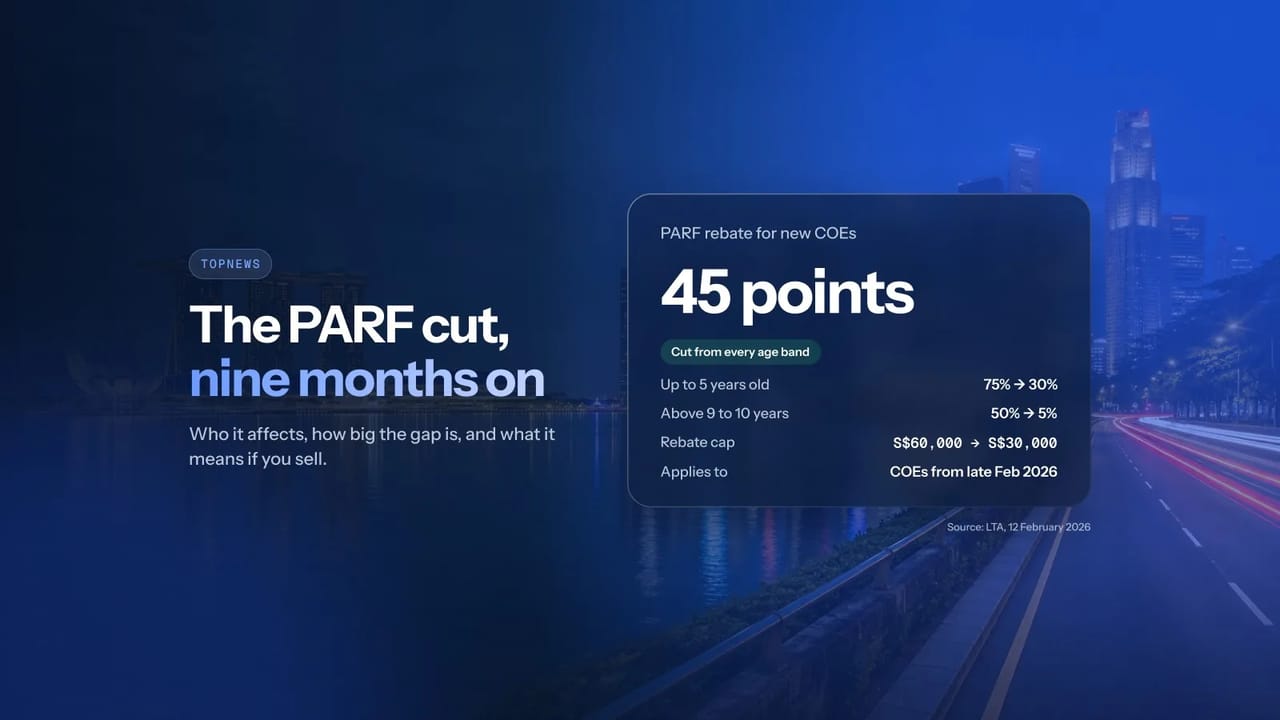
For most people selling a car today, the answer is no. The cut only applies to cars with COEs from the second February 2026 bidding exercise onwards, so almost every car on the used market still carries the old, more generous rebate. Here is who the change does affect, how big the difference is, and what it means if you plan to sell.
Information as of 16 November 2026. Rates are from LTA and OneMotoring.
What changed in February 2026
LTA announced the revision on 12 February 2026, alongside the Budget 2026 statement. The Preferential Additional Registration Fee (PARF) rebate is the amount you get back from the Additional Registration Fee (ARF) when you deregister a car before it turns 10. The rebate falls as the car gets older, and it is paid together with any COE rebate.
The new schedule takes 45 percentage points off every age band. The cap on the rebate also drops from S$60,000 to S$30,000.
Age at deregistration | Earlier rate (% of ARF paid) | Rate for COEs from Feb 2026 (2nd exercise) |
|---|---|---|
Up to 5 years | 75% | 30% |
Above 5 to 6 years | 70% | 25% |
Above 6 to 7 years | 65% | 20% |
Above 7 to 8 years | 60% | 15% |
Above 8 to 9 years | 55% | 10% |
Above 9 to 10 years | 50% | 5% |
More than 10 years | Nil | Nil |
Source: LTA, Revision of PARF Rebate Schedule and Cap, 12 February 2026. Cars with COEs from February 2023 to February 2026 have a S$60,000 cap. Cars with COEs from before February 2023 have no cap.
LTA's reason is that PARF exists to encourage owners to replace cars sooner, so the fleet stays safer and less polluting. With electric cars becoming more common, it says that push is less needed.
Which cars it applies to
Cars with a COE from the second February 2026 exercise onwards
These are the only cars on the new schedule. Even the oldest of them is only about nine months old today.
Cars registered before that
Their PARF stays on the schedule that applied when they were registered. Nothing about the February change reaches back to them.
COE-exempt cars such as taxis
The new schedule applies to those registered on or after 13 February 2026.
Cars that get no PARF at all
Goods-cum-passenger vehicles, classic and vintage cars, and laid-up vehicles were never eligible, so nothing changes for them.
So if you bought your car before late February 2026, its PARF rebate is exactly what it was before the Budget. You can check the figure on your car's LTA record, and our car depreciation calculator shows it alongside your annual depreciation.
Our PARF rebate guide shows how to work out your own figure, step by step.
How big is the difference?
Because the cut is a flat 45 percentage points, the gap between the old and new rebate stays the same at every age, as long as neither cap applies. It is simply 45% of the ARF paid. That makes the effect easy to see with two example cars. These are our own illustrative numbers, using the current ARF tiers (100% of the first S$20,000 of Open Market Value, 140% of the next S$20,000 and 190% of the next S$20,000).
Example car | OMV | ARF paid | PARF at 5 years, old schedule | PARF at 5 years, new schedule | Difference |
|---|---|---|---|---|---|
Mass-market hatchback | S$30,000 | S$34,000 | S$25,500 | S$10,200 | S$15,300 |
Mid-range sedan | S$45,000 | S$57,500 | S$43,125 | S$17,250 | S$25,875 |
Now look at the same hatchback across its life. Under the old schedule, its PARF rebate falls from S$25,500 to S$17,000 between year five and year ten. Under the new one, it falls from S$10,200 to just S$1,700.
Age at deregistration | Hatchback, old schedule | Hatchback, new schedule |
|---|---|---|
Up to 5 years | S$25,500 | S$10,200 |
Above 7 to 8 years | S$20,400 | S$5,100 |
Above 9 to 10 years | S$17,000 | S$1,700 |
The cap matters more for pricier cars. A car with an OMV of S$80,000 pays S$136,000 in ARF. Under the old schedule its rebate would have hit the S$60,000 cap at every age. Under the new one it is capped at S$30,000 in the early years, then falls to S$6,800 by year ten.
What sellers actually see today
If your car was registered before late February 2026, the floor under your car has not moved. Paper value, the PARF rebate plus the COE rebate you would get if you deregistered today, is still worked out on the old schedule. Our guide to how much your car is worth shows how that floor fits into a real price.
The COE rebate was not part of the change either. If you want the detail on that half, see our guide to calculating your COE rebate before deregistering .
Very few new-schedule cars can be sold yet. A car with a Cat A or Cat B COE can't be transferred within three months of registration, and a buyer may pay an extra levy if it changes hands four to six months after registration. Add the short time since February and there are only a small number of these cars on the used market so far.
When they do arrive, their floor will be lower. A two-year-old car on the new schedule carries a much smaller PARF rebate than a two-year-old car registered a year earlier. More of its price will depend on what buyers will pay for it as a car, and less on what it is worth if deregistered.
Ten-year decisions stay the same for now. At a car's 10-year mark, PARF drops to nil under every schedule. So the choice to renew your COE or scrap your car works the same way it always has for today's 9 and 10-year-old cars.
The difference is that, for cars on the new schedule, the rebate given up by renewing will be much smaller when their turn comes. Our guide to five-year versus ten-year COE renewal covers the renewal side.
What the Government expected
Acting Transport Minister Jeffrey Siow told Parliament on 4 March 2026 that the change was unlikely to significantly affect whether owners renew their COEs. He noted that Cat B premiums fell 5.3% in the first bidding exercise after the revision, while prices were otherwise largely stable. He also estimated that fewer than 2,000 buyers who had already committed to a purchase would be affected, mainly those buying higher-end petrol or diesel cars.
COE premiums have stayed high since then. Cat A hit a record S$139,001 in the first November exercise, then eased to S$130,100 on 18 November. Our 18 November COE Check has the latest results.
Why the registration date matters when you compare cars
If you are selling and replacing your car, the change shows up most when you compare a used car with a new one. Two cars of the same model and age can now carry very different rebates, depending only on when their COE was obtained.
For a seller, that means a buyer comparing your car with a slightly newer one may see a bigger floor under yours. It is worth knowing your car's exact PARF figure so you can point to it.
For a buyer, it means checking the registration date and the PARF figure on the LTA record, not assuming every car of a given age carries the same rebate.
For anyone weighing export or scrapping early, the trade-off changes for new-schedule cars, because the PARF part of the payout is much smaller. Our guide to export vehicles in Singapore covers how that route works.
What to watch next
The first new-schedule cars are only now passing the six-month mark, so the clearest picture will come in 2027, as more of them appear on the used market. COE premiums matter too. The next bidding exercise closes on 18 November, and the last two of the year close on 9 and 23 December. Separately, LTA's review of COE categories is due to report in the first half of 2027.
FAQ
Does the PARF cut affect my car?
Only if your car's COE came from the second February 2026 bidding exercise or later. Cars registered before that keep the PARF schedule that applied when they were registered.
How much less PARF do new cars get?
The rate is 45 percentage points lower in every age band, and the cap is S$30,000 instead of S$60,000. For a car that paid S$34,000 in ARF, that is S$15,300 less at any age up to 10 years.
Did the COE rebate change too?
No. The February 2026 revision covered the PARF rebate schedule and cap only.
Does PARF still drop to zero at 10 years?
Yes. Under every schedule, a car that is more than 10 years old at deregistration gets no PARF rebate.
Where can I check my car's PARF rebate?
Your car's LTA record shows its PARF eligibility and rebate. An LTA access code lets you share those official details. Our guide explains how to get an LTA access code for your vehicle .
Thinking about selling?
Topbid launches in January 2027. Our verified partners bid on your car, and you see every bid as it comes in. Join the waitlist and your first sale is free.