How the COE Quota Works, and What It Means for Car Sellers
How LTA sets the COE quota, why Cat A supply has shrunk while Cat B has grown, and how to read each new quota announcement if you plan to sell your car.
Every three months, LTA announces how many COEs it will release for bidding. That number, the COE quota, sets the supply side of every bidding exercise in the quarter. It is one of the few things that can move COE premiums before a single bid is placed, and it shapes new-car prices and, indirectly, what a used car is worth.
This guide explains how LTA works out the quota, how it has moved over the past year, how to read a new quota announcement, and what it all means if you plan to sell your car.
Data as of 26 October 2026. The latest published quota covers November 2026 to January 2027, announced by LTA on 26 October.
What the COE quota is
The COE quota is the number of Certificates of Entitlement LTA releases for bidding in each category over a three-month period. LTA announces it every quarter, for the bidding periods starting in February, May, August and November. The quarterly total is then split across the six bidding exercises in that period.
Each category has its own quota:
Category | Covers |
|---|---|
A | Cars up to 1,600cc and 97kW (130bhp), and electric cars up to 110kW |
B | Cars above 1,600cc or 97kW, and electric cars above 110kW |
C | Goods vehicles and buses |
D | Motorcycles |
E | Open: any vehicle except motorcycles |
Because every successful bidder in a category pays the same final premium, supply matters a great deal. A few hundred certificates more or less in a quarter can change how many bidders miss out in each exercise, and so where the premium settles.
How LTA works out the quota
The quota is built from three parts. LTA's annex to each announcement shows the working, and the August to October 2026 one is a good example.
1. Allowed growth in the vehicle population. For cars and motorcycles this is zero. LTA has set the growth rate for Cat A, B and D at 0% until 31 January 2028. Only Cat C, for goods vehicles and buses, gets a small allowance of 0.25% a year, which worked out to 95 certificates for the quarter.
2. Replacements for deregistered vehicles. This is by far the biggest part. When a vehicle is deregistered, its COE goes back into the pool. LTA takes the deregistrations over the past four quarters, removes the ones it has set aside for redistribution, and releases a quarter of the rest. Since February 2023 it has used this rolling four-quarter average to smooth out spikes.
3. Adjustments. These cover changes in the taxi population, the Early Turnover Scheme for commercial vehicles, expired temporary COEs, and redistributed or additional COEs. Since February 2025, LTA has also been progressively injecting up to about 20,000 additional COEs over several years, and these appear in the adjustment line too.
There is one more step. Since May 2017, 10% of the replacement COEs from Cat A, B and C are moved into Cat E, the open category. Motorcycles no longer contribute.
Here is how the August to October 2026 quota came together for the two car categories:
Step | Cat A | Cat B |
|---|---|---|
Deregistrations, Jul 2025 to Jun 2026 | 33,941 | 26,321 |
Less: guaranteed deregistrations set aside | -3,277 | -1,852 |
25% of effective deregistrations | 7,666 | 6,117 |
Less: 10% moved to Cat E | -766 | -611 |
Adjustments (expired temporary COEs, redistribution) | +234 | +21 |
Quota for Aug to Oct 2026 | 7,134 | 5,527 |
Source: LTA, Annex A to the COE quota announcement for August to October 2026.
How the quota has moved over the past year
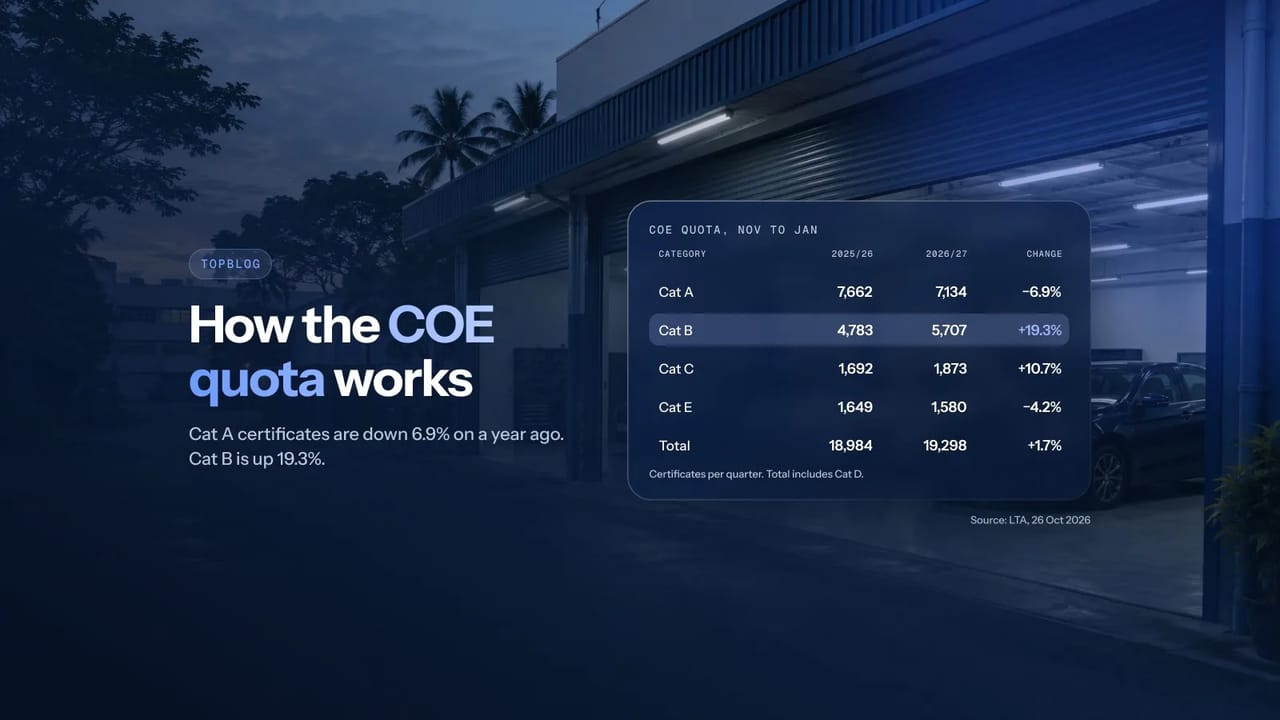
The newest quota, for November 2026 to January 2027, is 19,298 COEs across all categories, 213 or 1.1% more than August to October. Cat A is unchanged at 7,134, while Cat B rises by 180 to 5,707. Cat C rises by 37 to 1,873, Cat E by 57 to 1,580, and Cat D falls by 61 to 3,004. Spread over six exercises, that is roughly 1,189 Cat A and 951 Cat B certificates per round, before any unused certificates are carried forward. LTA says the new quota is not affected by its ongoing review of COE categories for cars.
The bigger story is the direction of travel. Over the past five quarters, Cat A supply has shrunk while Cat B supply has grown.
Category | Nov 2025 to Jan 2026 | Feb to Apr 2026 | May to Jul 2026 | Aug to Oct 2026 | Nov 2026 to Jan 2027 |
|---|---|---|---|---|---|
A | 7,662 | 7,585 | 7,434 | 7,134 | 7,134 |
B | 4,783 | 4,864 | 5,205 | 5,527 | 5,707 |
C | 1,692 | 1,742 | 1,742 | 1,836 | 1,873 |
D | 3,198 | 3,198 | 3,145 | 3,065 | 3,004 |
E | 1,649 | 1,435 | 1,526 | 1,523 | 1,580 |
Total | 18,984 | 18,824 | 19,052 | 19,085 | 19,298 |
Source: LTA quota announcements and Annex A tables for each period.
Cat A has lost 528 certificates a quarter in a year. That is a fall of 6.9%, from 7,662 to 7,134. The slide has paused for now: after a drop of 300 in August to October, Cat A is unchanged at 7,134 for November to January.
Cat B has gained 924. Cat B rose 19.3%, from 4,783 to 5,707, including rises of 322 in August to October and 180 in the new quarter.
The total has barely moved. Overall supply is up 314 certificates, or 1.7%, on a year ago. The shift is between categories, not in the size of the pool.
This helps explain a pattern seen through 2026. With fewer Cat A certificates on offer and steady demand for mass-market cars, Cat A has closed above Cat B in four exercises this year, most recently on 21 October, when it finished at S$132,004 against S$131,901 for Cat B. Our COE Check for 21 October has the full results and a round-by-round table.
What stays fixed from one quota to the next
Some parts of the quota change slowly, or are set well in advance. Knowing them makes each new announcement easier to read.
Car growth is zero. The 0% growth rate for Cat A, B and D runs until 31 January 2028. Until then, the car quota comes almost entirely from replacing deregistered vehicles.
Some adjustments span two quarters. For example, between January and June 2026, 439 taxis were registered and 372 deregistered, a net 67 more. LTA is deducting those from Cat E over two quarters, August to October 2026 and November 2026 to January 2027.
The deregistration window rolls forward. Each new quota drops the oldest quarter of deregistrations and adds the most recent. So whether Cat A supply shrinks or grows depends on how many smaller cars reached the end of their COE and were deregistered in the latest quarter, compared with the same quarter a year earlier.
Six exercises a quarter. Bidding usually runs twice a month, so each quarterly quota is shared across six exercises. Unused certificates are carried forward to a later exercise. LTA publishes each year's bidding schedule in advance on OneMotoring.
How to read a new quota announcement
Cat A against Cat B. Compare each category with the previous quarter, not just the total. When Cat A supply falls while Cat B rises, as it has through 2026, it adds pressure to Cat A premiums. If the trend reverses, the gap between the two could reopen. Either way, supply is only half the picture. Demand, the number of bids each round, matters just as much.
The total. A larger total does not automatically mean lower premiums, but a meaningful drop in supply across the board would be worth noting for the rounds that follow.
Cat E. The open category takes its share from Cat A, B and C, and has mostly been used for Cat B cars. On 21 October 2026, it closed at S$135,790, the highest of all five categories.
Demand-side changes. Supply is only half the story. For example, LTA's EV Early Adoption Incentive, a rebate of 45% off the Additional Registration Fee capped at S$7,500 for electric cars registered in 2026, ends on 31 December 2026. Changes like this can pull demand into the last bidding rounds before they take effect.
Category changes. In October 2026, LTA proposed merging Cat A and B into one car category, with a rebate or surcharge by model. A merged category would mean one car quota instead of two. It is still a proposal. Here's what LTA is proposing.
What the quota means if you're selling
COE supply affects used-car values indirectly. It moves the price of new cars first, through the COE premium, and that shapes what buyers are willing to pay for a used car instead. A tighter quota and higher premiums can support used-car demand. A looser quota can do the opposite.
But no quota announcement will tell you what your own car is worth. That still comes down to its remaining COE, its PARF or paper value, its mileage and its condition. So it is better to know your own numbers than to try to time the market around a supply figure.
Know your depreciation. Our car depreciation calculator shows your annual depreciation and PARF rebate in seconds.
Get your LTA record ready. An LTA access code lets you share your car's official details securely.
COE expiring soon? Our guide on whether to renew your COE or scrap your car compares the costs and rebates.
Still paying off your car? Here's what happens when you sell a car with an outstanding loan.
FAQ
When does LTA announce the COE quota?
Every quarter, in the month before a new bidding period starts: January for February to April, April for May to July, July for August to October, and October for November to January. The November 2026 to January 2027 quota was published on 26 October 2026.
How is the COE quota calculated?
Mostly from deregistrations. LTA takes the vehicles deregistered over the previous four quarters, removes those set aside for redistribution, and releases a quarter of the rest. It then adds any allowed growth and adjustments, and moves 10% of the Cat A, B and C replacements into Cat E.
Why is the Cat A quota falling?
Mostly because fewer Cat A certificates have been coming back from deregistered cars over the rolling four-quarter window. Redistribution and other adjustments also play a part. Cat A's quota has fallen from 7,662 in November 2025 to January 2026 to 7,134 in August to October 2026, and stays at 7,134 for November 2026 to January 2027.
Does a bigger quota mean lower COE prices?
Not on its own. More supply helps, but premiums depend on how many people bid in each round. Cat A premiums rose through much of 2026 even though the total quota stayed close to 19,000.
Is the vehicle growth rate still zero?
Yes, for cars and motorcycles. LTA has set the growth rate for Cat A, B and D at 0% until 31 January 2028. Cat C grows at 0.25% a year.
Thinking about selling?
Topbid launches in January 2027. Our verified partners bid on your car, and you see every bid as it comes in. Join the waitlist and your first sale is free.