How to Give LTA Feedback on Its COE Proposal Before 2 November
LTA's COE category consultation closes on 2 November. Here are the five questions it asks, how to submit your feedback, and the points we would raise.
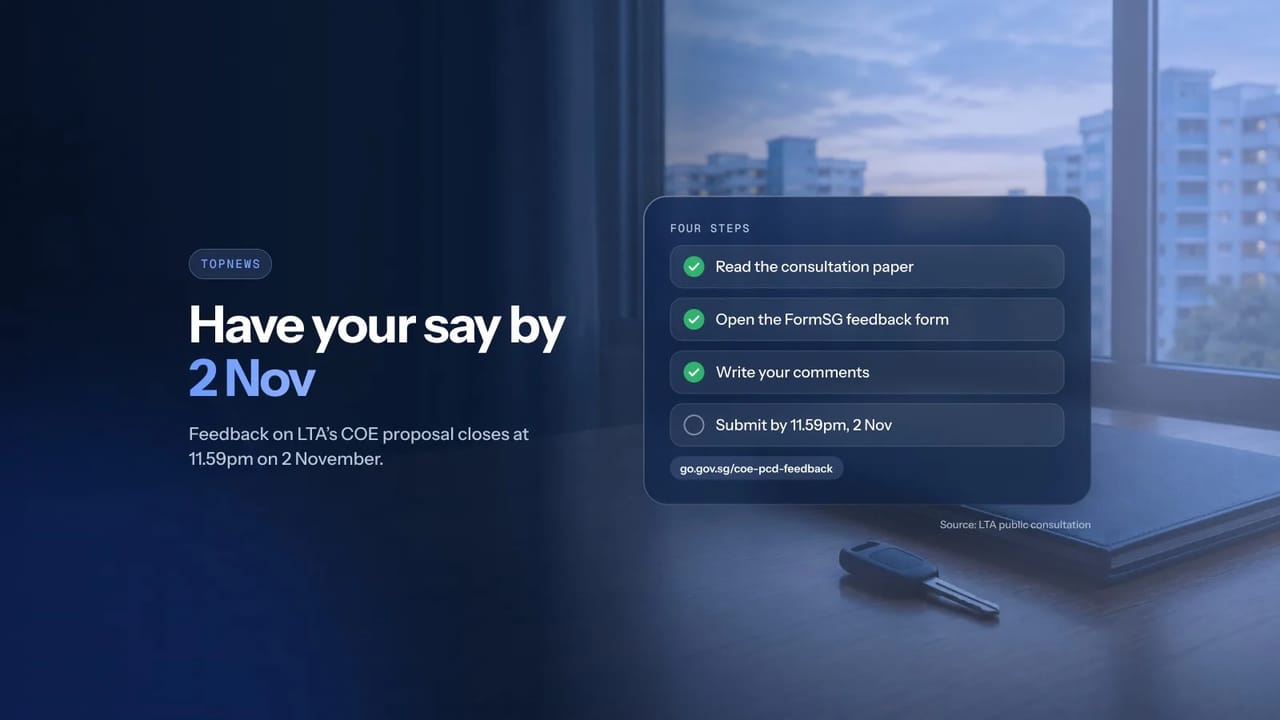
The Land Transport Authority (LTA) is asking the public whether COE Categories A and B should be merged into a single car category, and how a merged system should work. Feedback closes at 11.59pm on 2 November 2026. If you own a car, plan to buy one, or are thinking about selling, this is the moment your view counts most, because nothing has been decided yet.
This guide covers what LTA is asking, how to submit your feedback, how to make your comments useful, and the points we would raise ourselves. If you're new to the proposal, start with our explainer on what LTA is proposing for Cat A and B.
Information as of 26 October 2026.
The proposal in brief
Today, a car's engine capacity and power decide whether it needs a Cat A or a Cat B COE. LTA says these rules no longer separate mass-market cars from higher-value ones as well as they used to. Electric cars don't fit neatly into engine-based rules, and some models are tuned to fit under the Cat A limits. Cat A closed above Cat B in three rounds between February and June 2026, and again on 21 October. In the 7 October round the two closed just S$99 apart.
LTA's answer is one passenger car category with one COE price, plus a "feebate": a rebate for lower-value models and a surcharge for higher-value ones, based on each model's median Open Market Value (OMV). It has put forward two designs, one with three bands and one with five, with adjustments of up to S$15,000 either way. It is also asking what should happen to Cat E, the open category, if Cat A and B merge.
LTA engaged more than 200 people in April and May 2026 before publishing the paper, and says participants generally agreed the A and B split had become less meaningful. The public consultation is the next step. LTA expects to complete its review by the end of 2026 and share its recommendations in the first half of 2027.
The five questions LTA is asking
LTA's summary of the consultation sets out five areas it wants views on. Here they are, with what each one means in practice.
# | LTA's question | What it means for you |
|---|---|---|
1 | Whether a single passenger car category with a feebate system should be introduced, to keep a difference between mass-market and higher-value cars | The big one: one COE for all cars, with the price gap restored through rebates and surcharges instead of separate categories |
2 | Whether median OMV is an appropriate basis for deciding a car's feebate band | Your band would follow your model's typical import value, not the price you paid or the car's engine |
3 | Whether a three-band or five-band structure is preferred | Three bands are simpler but mean S$15,000 jumps between neighbouring bands; five bands have S$7,500 steps but more complexity |
4 | Whether the feebate should apply to COE renewals | Matters most if your car is approaching year 10 and you plan to renew |
5 | How Cat E should be adjusted if Cat A and B are merged | Affects buyers who need a car urgently and use the open category |
You don't have to answer every question. A short, specific answer to the one that affects you most is more useful than a long general comment.
How to submit your feedback
LTA is taking written comments through an online form. Here's how to do it.
Read the proposal first. LTA's consultation paper (PDF) explains each option and the trade-offs. The two band tables and the section on renewals are the parts most owners will want to read.
Open the feedback form. It's at go.gov.sg/coe-pcd-feedback, on the government's FormSG platform.
Write your comments. Focus on the questions that matter to you, and say why.
Submit before 11.59pm on 2 November 2026.
The paper doesn't list an email address or another channel, so the online form is the way to have your say.
How to make your feedback count
Consultations receive a lot of comments. The ones that shape policy tend to be specific and grounded in real situations. A few pointers:
Say who you are. "I own a 9-year-old Cat A car and plan to renew next year" or "I'm a first-time buyer looking at a family MPV" tells LTA whose situation your view reflects.
Answer the question asked. If you think three bands are too blunt, say so, and say which models or price points you think would be treated unfairly.
Use real numbers. If a S$15,000 surcharge would change which car you buy, say that. If you think the jump between bands is too large, say what step size would feel fair.
Offer an alternative. If you disagree with an option, suggest what would work better. "Smaller steps near the band edges" is more useful than "this is unfair".
Keep it short. A few clear paragraphs are easier to weigh than a long essay.
A closer look at each question
Should Cat A and B merge, with a feebate?
LTA's argument is that mass-market and higher-value cars take up roughly the same road space, so they should draw from the same pool of COEs. A larger single pool could also make COE prices less volatile. The feebate is there to keep a price gap between mass-market and luxury buyers, which LTA lists as one of its guiding principles alongside efficient allocation and an open, transparent framework.
The question for you is whether this is a better way to keep that gap than today's engine-based categories, which have struggled with electric cars and with models tuned to fit Cat A.
Is median OMV the right yardstick?
OMV is the import value of a car, assessed by Singapore Customs. It already decides the Additional Registration Fee (ARF). LTA would take each model's median OMV across past registrations, rank models by percentile, and sort them into bands. Where a model has no past data, the specific car's OMV would stand in. LTA chose OMV over selling prices because selling prices are easier to manipulate. Bands would be reviewed every year and published, so buyers know the rebate or surcharge before they buy, and retailers could appeal a model's band.
If you think OMV misses something, for example how well-equipped a variant is, this is where to say so.
Three bands or five?
Design | Band edges (median OMV percentile) | Adjustment |
|---|---|---|
Three bands | 0 to 35th / 35th to 50th / above 50th | S$15,000 rebate / none / S$15,000 surcharge |
Five bands | 0 to 10th / 10th to 35th / 35th to 50th / 50th to 75th / above 75th | S$15,000 rebate / S$7,500 rebate / none / S$7,500 surcharge / S$15,000 surcharge |
Under either design, the most a higher-value car would pay over a mass-market car is S$30,000. LTA notes the historical gap between Cat A and Cat B premiums was a reference point for these figures.
LTA is open about the trade-off. Three bands are simpler to understand and run, but two similar models either side of a band edge could end up S$15,000 apart. Five bands smooth those jumps out, at the cost of more complexity. LTA's paper lists example models for each band based on 2025 registrations. In the three-band design, for example, the BYD Atto 3, Honda Freed and Toyota Sienta sit in the rebate band, while the Audi Q3, BMW iX2, Tesla Model Y RWD and Toyota Alphard sit in the surcharge band.
Should the feebate apply when you renew?
When a COE ends after 10 years, owners can renew it by paying the Prevailing Quota Premium (PQP), the three-month moving average of COE prices. With one car category, there would be one PQP. LTA suggests the feebate may not need to apply to renewals, because Cat A and Cat B prices have already converged. In October 2026, a 10-year renewal cost S$128,715 for Cat A and S$131,616 for Cat B, a gap of S$2,901.
LTA also says transitional arrangements could be considered for existing owners, such as owners of mass-market cars. There are no details yet. If you plan to renew in the next few years, this is the question to weigh in on.
What should happen to Cat E?
Cat E, the open category, can be used to register a Cat A, B or C vehicle. It's useful for buyers who need a car urgently, and its temporary COEs can be transferred if an individual made the bid. Since May 2017, Cat E has received 10% of the COEs freed up when Cat A, B and C vehicles are deregistered. LTA says buyers mostly use it for Cat B cars, so after a merger it would mainly serve cars and goods vehicles.
LTA sets out two options. Removing Cat E would make the system simpler, but buyers in a hurry would have to wait for the next bidding exercise. Keeping Cat E for cars only would preserve that option without affecting the supply of Cat C COEs for goods vehicles and buses.
Other ideas LTA looked at
The paper also responds to suggestions LTA heard during its earlier engagement. These are not being proposed now, but they show where LTA's thinking is.
Easier bidding for individuals. Rather than restrict dealers, LTA wants to make it easier for individuals to bid directly. Today, individuals pay S$2 per bid or bid revision and motor dealers pay S$8 or S$10. LTA is working on letting individuals submit their first bid online and is reviewing these fees.
Car prices without the COE. LTA is considering ways to have car prices published without the COE bundled in, so buyers can compare cars more easily.
Pay-as-you-bid. Some suggested that each bidder should pay their own bid rather than a single clearing price. LTA thinks this is unlikely to lower prices, noting that around two in three Cat A and B bids in 2025 were within 5% of the clearing price.
Large families. LTA says allocating COEs by family profile would be hard to do fairly. Instead, the Government will provide a transport grant for large families with three or more Singapore Citizen children, with details to come.
Private-hire cars and multiple-car owners. LTA isn't pursuing a separate category for private-hire cars or a surcharge on owning more than one car. It notes that households with more than one car fell from about 19% in 2012 to about 13% in 2025.
What we'd say
We built Topbid because the used car market in Singapore has long favoured whoever has more information. We think that should be the seller. That shapes how we read this consultation.
Price transparency first. We'd encourage LTA to go ahead with publishing car prices without the COE, and with online bidding for individuals. Clear new-car prices make it easier to value a used car, which helps every seller.
If the categories merge, keep the steps small. Under three bands, two similar cars could land S$15,000 apart because of where a band edge falls. Five bands halve that jump. We'd lean towards the design that treats neighbouring models most fairly, even if it is a little more complex.
Give owners a clear answer on renewals. Many owners decide whether to renew, sell or scrap years in advance. They need to know whether the feebate will apply when they renew, and what any transition looks like for someone who bought a Cat A car under today's rules.
Publish the bands early. Buyers and sellers both benefit from knowing a model's band well before any change takes effect, so prices can adjust gradually rather than overnight.
You may see it differently, and that's the point of the consultation. Whatever your view, it's worth a few lines before 2 November.
Key dates
Date | What happens |
|---|---|
8 Oct 2026 | Consultation opened |
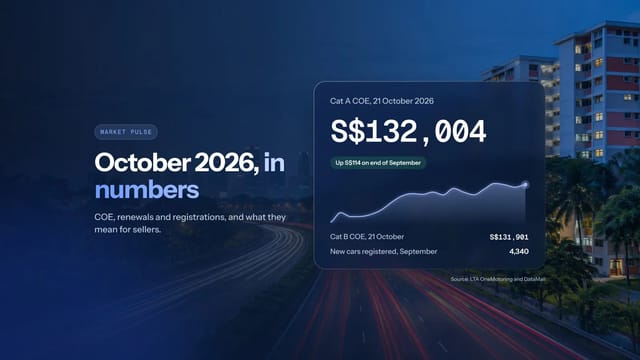
21 Oct 2026, 4pm | COE results, October 2nd exercise (Cat A S$132,004, Cat B S$131,901) |
2 Nov 2026, 11.59pm | Feedback closes |
4 Nov 2026, 4pm | COE results, November 1st exercise |
End of 2026 | LTA aims to complete its review |
First half of 2027 | LTA shares findings and recommendations |
FAQ
When does the COE consultation close?
At 11.59pm on 2 November 2026.
Where do I submit my feedback?
Through LTA's online feedback form at go.gov.sg/coe-pcd-feedback. The consultation paper doesn't list another channel.
Do I need to answer every question?
No. Focus on the questions that affect you, and explain why.
Will the proposal change my car's COE now?
No. It's a consultation, and nothing changes today. LTA says transitional arrangements for existing owners could be considered if the proposal goes ahead.
When will LTA decide?
LTA expects to complete its review by the end of 2026 and share its recommendations in the first half of 2027.
Thinking about selling?
Topbid launches in January 2027. Our verified partners bid on your car, and you see every bid as it comes in. Join the waitlist and your first sale is free.