COE Feebate Explained: Three Bands vs Five, With Examples
Three bands or five? A labelled, hypothetical example shows how LTA's proposed COE feebate could change the price of two similar cars.
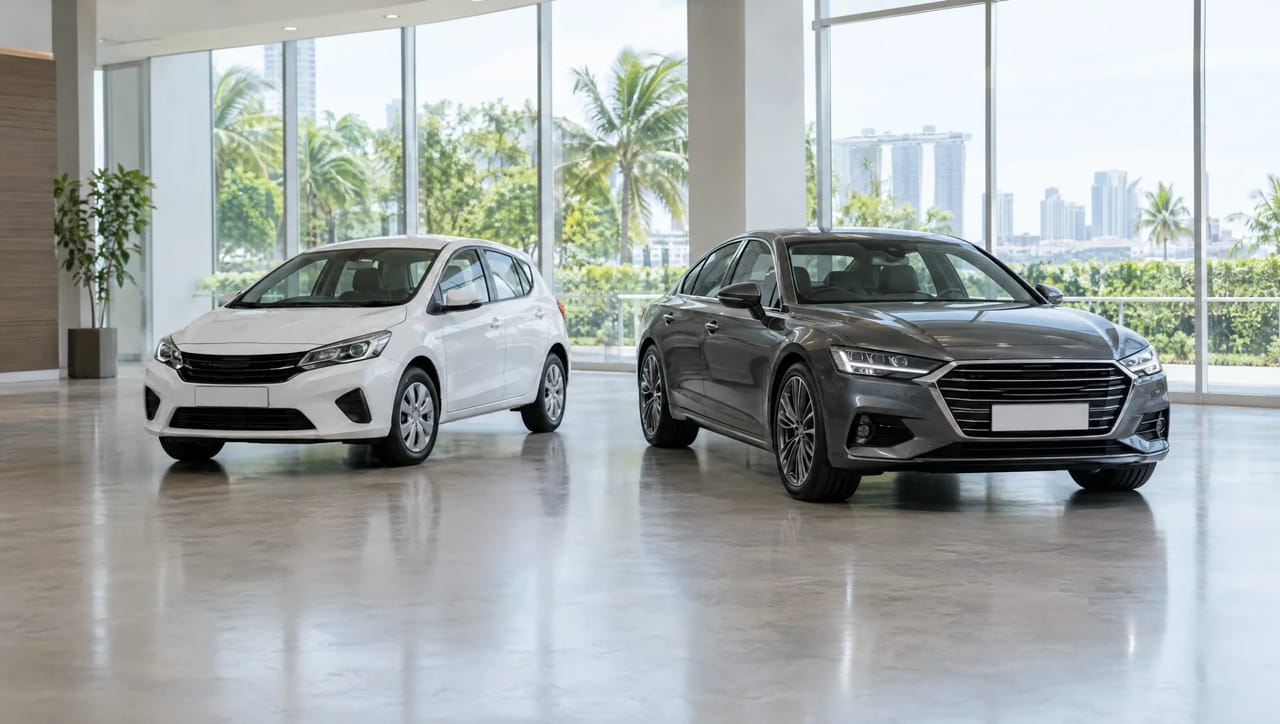
This guide explains how the feebate would work, then works through both designs with numbers. We take LTA's own indicative bandings for real models, apply them to a hypothetical COE price, and show where the two designs agree and where they don't. LTA is taking public feedback until 11.59pm on 2 November 2026.
Information as of October 2026, based on LTA's consultation paper. All worked examples are hypothetical and for illustration only.
How the proposed COE feebate works
Today, a car's engine size and power decide whether it needs a Cat A or a Cat B COE. LTA says those rules no longer separate mass-market cars from higher-value ones as well as they used to. By October 2026, Cat A had closed above Cat B in four bidding exercises that year, even though it is meant for smaller, mass-market cars.
Under the proposal, all car buyers would bid for the same COE. A "feebate" would then be applied to the prevailing COE price, depending on the car model:
a rebate for lower-value models
no adjustment for models in the middle
a surcharge for higher-value models
The band would be set by the model's median Open Market Value (OMV), ranked as a percentile against other models. It would not depend on the price you paid or the car's engine. Bands would be reviewed and published every year, and car retailers could appeal a model's band. If there is no past data for a model, the specific vehicle's OMV would be used instead.
For the full background, read our explainer on what LTA is proposing for Cat A and B.
The two designs side by side
Here are both options from LTA's consultation paper. The percentile ranges are the same in places, but the steps between bands are not.
Median OMV percentile | Three bands | Five bands |
|---|---|---|
0 to 10th | S$15,000 rebate | S$15,000 rebate |
10th to 35th | S$15,000 rebate | S$7,500 rebate |
35th to 50th | No adjustment | No adjustment |
50th to 75th | S$15,000 surcharge | S$7,500 surcharge |
Above 75th | S$15,000 surcharge | S$15,000 surcharge |
Source: LTA, Public consultation paper on COE categorisation for cars, 8 October 2026.
A few things follow straight from the table.
The extremes are the same. Models up to the 10th percentile get a S$15,000 rebate and models above the 75th percentile pay a S$15,000 surcharge under either option. So the most a higher-end car would pay over a mass-market car is S$30,000 in both designs.
The middle is the same. Models between the 35th and 50th percentile get no adjustment under either option.
The difference is in the shoulders. Models between the 10th and 35th percentile, and between the 50th and 75th, get half the adjustment under five bands. That is where most of the trade-off sits.
Which models land where
LTA published example models for each band, based on cars registered in 2025. It stresses that the lists are indicative, not exhaustive, and would be reviewed every year.
Example model (LTA's list) | Three bands | Five bands |
|---|---|---|
Mazda 3, Honda Jazz, Suzuki Swift | S$15,000 rebate | S$15,000 rebate |
Honda Freed, Toyota Sienta, Toyota Noah | S$15,000 rebate | S$7,500 rebate |
Audi A3, Nissan Serena, Toyota Corolla Altis, Honda Civic 1.5 Turbo | No adjustment | No adjustment |
Audi Q3, BMW 216, Honda Odyssey, Mercedes-Benz A180 | S$15,000 surcharge | S$7,500 surcharge |
BMW iX2, Honda Civic Type R, Tesla Model Y RWD, Toyota Alphard | S$15,000 surcharge | S$15,000 surcharge |
Source: LTA consultation paper, Tables 1 and 2. Bandings are indicative and based on 2025 registrations.
Worked examples: five pairs of cars
To make the numbers concrete, we need a COE price. Nobody knows what a merged car COE would cost, so we have picked a round S$130,000 as a hypothetical. It is close to where Cat A and Cat B closed in October 2026, but it is not a forecast. The feebate is a fixed amount, so the gaps between cars stay the same whatever COE price you pick.
In each pair below, the "COE cost" is the hypothetical COE price plus or minus the feebate. It leaves out everything else in a car's price, such as OMV, ARF, VES and the dealer's margin.
Pair 1: two versions of the same car
LTA's tables place the BYD Sealion 7 Dynamic in the middle band and the Sealion 7 Performance in the surcharge band.
Hypothetical COE cost | Sealion 7 Dynamic | Sealion 7 Performance | Gap |
|---|---|---|---|
Three bands | S$130,000 | S$145,000 | S$15,000 |
Five bands | S$130,000 | S$137,500 | S$7,500 |
This is the trade-off LTA itself flags. With fewer bands, the adjustments between neighbouring bands are larger. Five bands halve the gap between two versions of the same model.
Pair 2: two family MPVs
The Honda Freed sits in a rebate band. The Nissan Serena sits in the middle band.
Hypothetical COE cost | Honda Freed | Nissan Serena | Gap |
|---|---|---|---|
Three bands | S$115,000 | S$130,000 | S$15,000 |
Five bands | S$122,500 | S$130,000 | S$7,500 |
Under three bands, the Freed gets the full S$15,000 rebate. Under five, it gets S$7,500. Buyers comparing the two would see a much bigger COE difference under three bands.
Pair 3: two premium hatchbacks
The Audi A3 sits in the middle band. The Mercedes-Benz A180 sits just above it.
Hypothetical COE cost | Audi A3 | Mercedes-Benz A180 | Gap |
|---|---|---|---|
Three bands | S$130,000 | S$145,000 | S$15,000 |
Five bands | S$130,000 | S$137,500 | S$7,500 |
Same pattern. These are cars many buyers would cross-shop, and the band edge falls between them.
Pair 4: where five bands create a gap
Five bands don't only shrink gaps. They can also open one up. The Mazda 3 and the Toyota Sienta are both mass-market cars in rebate bands.
Hypothetical COE cost | Toyota Sienta | Mazda 3 | Gap |
|---|---|---|---|
Three bands | S$115,000 | S$115,000 | None |
Five bands | S$122,500 | S$115,000 | S$7,500 |
Under three bands, both get the same S$15,000 rebate. Under five, the Mazda 3 keeps its full rebate because it sits in the lowest 10%, while the Sienta drops to S$7,500.
Pair 5: where the choice makes no difference
The Honda Civic 1.5 Turbo sits in the middle band. The Civic Type R sits in the top band under both designs.
Hypothetical COE cost | Civic 1.5 Turbo | Civic Type R | Gap |
|---|---|---|---|
Three bands | S$130,000 | S$145,000 | S$15,000 |
Five bands | S$130,000 | S$145,000 | S$15,000 |
For cars at the very top or bottom, or in the middle, the choice of three or five bands changes nothing.
What the example shows
Three bands are simpler, with bigger cliffs. Every band edge is worth S$15,000. Two cars a few percentiles apart can be treated very differently.
Five bands are smoother, but busier. The steps are S$7,500, so neighbouring models are closer. But there are four band edges instead of two, so more models sit near one.
Band edges move. LTA would review the bands every year. A model near the 35th or 50th percentile could move the band from one year to the next. Under three bands that move would be worth S$15,000. Under five, S$7,500.
The overall spread doesn't change. Under both designs, the gap between the cheapest and the most expensive band is S$30,000. The choice is about what happens in between.
What it could mean if you're selling
Start with what doesn't change. This is a proposal, not a decision. LTA expects to complete its review by the end of 2026 and share its recommendations in the first half of 2027. Your car keeps its current COE and category.
If a feebate is introduced, it would apply to new COEs, so it would mostly reach used cars through new-car prices. A new car that becomes cheaper because of a rebate competes harder with used versions of the same model. A new car that becomes dearer because of a surcharge can make a used one look better value. Which way that cuts for any one model, and by how much, is too early to say. LTA has also suggested the feebate may not need to apply to COE renewals, but that is still open.
So the advice stays the same. Don't time a sale around a proposal. Time it around your own car's numbers.
Know your depreciation. Our car depreciation calculator shows your annual depreciation and PARF rebate in seconds.
Get your LTA record ready. An LTA access code lets you share your car's official details securely.
COE expiring soon? Our guide on whether to renew your COE or scrap your car compares the costs and rebates.
Our take
We built Topbid because the used car market in Singapore has long favoured whoever has more information. We think that should be the seller. A feebate only works for buyers and sellers if people can see which band a car is in before they commit.
We haven't taken a side on three bands or five. Both have a case. But whichever LTA chooses, these are the questions we'd want answered:
Publishing the bands
Will each model's band, and the median OMV behind it, be easy to look up before a buyer signs?
Models near an edge
How will LTA treat a model that sits a fraction of a percentile from a band boundary, especially in its annual review?
Variants of the same model
LTA's examples band versions of one model separately, like the Sealion 7 Dynamic and Performance. Will that always be the case, and how will buyers know which version falls where?
FAQ
What is the difference between the three-band and five-band COE feebate?
Both give a S$15,000 rebate to the lowest-value models and a S$15,000 surcharge to the highest-value ones. Five bands add half-steps of S$7,500 for models between the 10th and 35th percentile and between the 50th and 75th percentile.
Would the feebate be based on what I pay for my car?
No. It would be based on the median OMV of the car's model across past registrations. If there is no past data, the specific vehicle's OMV would be used.
What is the largest difference the feebate could make?
S$30,000, between a model with a S$15,000 rebate and one with a S$15,000 surcharge. That is the same under both options.
Which option has LTA chosen?
Neither yet. LTA is asking for views on both. Feedback closes at 11.59pm on 2 November 2026, and LTA expects to share its recommendations in the first half of 2027.
Would the feebate apply when I renew my COE?
It is an open question. LTA suggests it may not need to, because Cat A and Cat B renewal costs have converged, and it is seeking views on this.
Thinking about selling?
Topbid launches in January 2027. Our verified partners bid on your car, and you see every bid as it comes in. Join the waitlist and your first sale is free.